

A lifetime of self-discipline, vision, and intellectual curiosity has contributed to Ray Dalio’s estimated net worth of $15.4 billion. His financial empire, which he established through Bridgewater Associates, continues to serve as a textbook for methodical thought and emotional restraint. His New York apartment experiment turned into a hedge fund behemoth that revolutionized contemporary investment.
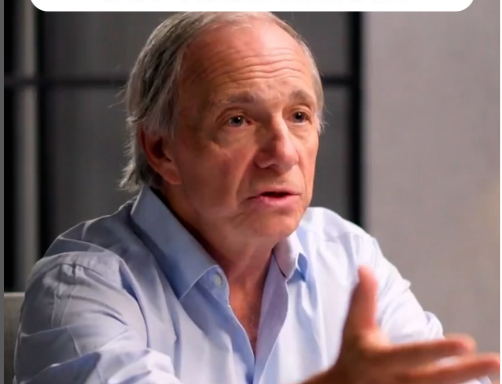
In 1975, Dalio established Bridgewater Associates with just his Harvard MBA and his conviction. His company developed over the years into a major international financial organization that now oversees assets worth around $92 billion. Known for its radical transparency and free debate, Bridgewater’s culture proved remarkably effective in managing tumultuous markets. Employees were encouraged by Dalio’s attitude to examine presumptions without fear, which reflected his own tendency to do so whenever possible.
Ray Dalio: Personal, Professional, and Financial Information
| Category | Details |
|---|---|
| Full Name | Raymond Thomas Dalio |
| Date of Birth | August 8, 1949 |
| Age | 76 years (as of 2025) |
| Place of Birth | New York City, United States |
| Education | B.S. from Long Island University (Post); MBA from Harvard Business School |
| Occupation | Hedge Fund Manager, Author, Investor, Philanthropist |
| Known For | Founder of Bridgewater Associates |
| Net Worth (as of December 2024) | $15.4 Billion (USD) |
| Major Works | Principles: Life & Work (2017), The Changing World Order |
| Spouse | Barbara Dalio |
| Children | Four sons, including Paul Dalio |
| Philanthropy | Founder of Dalio Philanthropies; donated over $1 billion |
His early interest in markets started almost by accident in his modest Long Island upbringing. He used the money he made caddying for Wall Street golfers to purchase his first stock, Northeast Airlines, when he was twelve years old. An fascination with market dynamics began, and the investment tripled. Dalio’s career would be defined by this early interest, which is remarkably similar to the early tales of other successful investors like Warren Buffett.
He has always had a highly creative way of thinking. Dalio took a systems-based approach to investing rather than depending on gut feelings or forecasts. He saw economies as intricate systems with moving components that could be investigated, evaluated, and comprehended. He created algorithms that balance risk and return with remarkable accuracy by fusing data analysis with in-depth historical research. Even when the world markets fell, Bridgewater was able to maintain a steady performance across decades thanks to this scientific approach.
Bridgewater grew to be the biggest hedge fund in the world in 2013, and Dalio’s name came to represent brilliant discipline. However, he maintained a humble management approach in spite of his enormous success. He was never afraid to own up to his faults, referring to them as “gifts” that, when honestly considered, provided opportunities for growth. These concepts were transformed into a useful manual for leadership and daily living in his book Principles: Life & Work. Its tone was really straightforward, distilling intricate insights into lessons that were incredibly useful for anyone looking for order in their decision-making.
Dalio’s professional path demonstrates that emotional fortitude and intelligence go hand in hand in creating riches. He frequently reminded investors that the secret to success in any industry is knowing how to suffer well—that is, how to grow from failures rather than run from them. This mentality has significantly changed how many business executives view failure, transforming it from a sign of failure into a tool for advancement.
After almost 50 years, Dalio retired as co-chief investment officer at Bridgewater in 2022, taking a break from day-to-day operations. Because of his careful and planned transition, the company remained stable long after he left. He sold his remaining Bridgewater stock by 2025, allowing him to devote more time to mentoring, philanthropy, and writing. His dramatic-free, elegant leave contrasted sharply with other billionaire entrepreneurs’ frequently tumultuous ones.
These days, Dalio’s impact goes much beyond the financial industry. The Changing World Order, his second major work, explores the rise and collapse of economies and nations over time. He used cycles of debt, innovation, and leadership as important markers to explain why certain systems succeed while others fail, drawing on millennia’ worth of data. The book provided frameworks that linked history to future strategy, which was especially helpful for investors and policymakers.
His way of thinking puts him in a unique position since it blends the intellectual curiosity of a historian with the analytical rigor of a financier. Dalio frequently relates economic trends to human psychology in his discussions, elucidating how bias, greed, and fear consistently influence results. His observations on the evolution of nations are not only well-researched but also incredibly sympathetic and human.
He has contributed more than $1 billion to charities like ocean exploration, microfinance, and education through Dalio Philanthropies. With a focus on opportunity for disadvantaged pupils, his family foundation has been very engaged in enhancing public education in Connecticut. His generosity is very effective and is based on quantifiable results rather than media attention. His generosity is based on facts, teamwork, and long-term vision, just like his investments.
Dalio maintains a rather modest lifestyle in spite of his enormous wealth. He frequently discusses the meaninglessness of financial wealth without a purpose, emphasizing that meaningful connections and lifelong learning are necessary for happiness. In a time when success is frequently confused with wealth, his observations are especially poignant. Dalio believes that contribution—the capacity to impart wisdom and worth—is the fundamental test of wealth.
His peers frequently characterize him as very contemplative and analytical. Bill Gates has commended Dalio’s economic cycle analysis, while Warren Buffett has praised his methodical approach. Despite having different ideologies—Dalio leans toward intricacy, while Buffett favors simplicity—they both have a strong regard for honesty and long-term planning. Their shared respect is indicative of a larger trend among contemporary billionaires: the development of wealth based on morality and clarity rather than conjecture.
In recent years, Dalio’s public profile has increased dramatically. Millions of people watch his TED Talks and interviews in search of guidance on making decisions and maintaining a healthy balance in their lives. He regularly stresses that one of the most crucial abilities one can acquire is comprehending reality and adjusting to it without ego. This statement, whose significance is incredibly resilient, goes far beyond finance.
He has a cultural impact as well. His “Principles” framework is cited by numerous political and commercial leaders as revolutionary for both individual and organizational development. Workplace cultures have changed as a result of the notion that openness and honesty can improve performance, motivating employees to choose the truth over comfort. Dalio’s views continue to influence the way businesses, educational institutions, and even governments make choices.
